
A new report profiling the troubles AT&T has faced with millions of bandwidth hungry iPhone users revealed Tuesday that Apple has modified its handset to make it less taxing on its wireless partner’s network.
Read more…

A new report profiling the troubles AT&T has faced with millions of bandwidth hungry iPhone users revealed Tuesday that Apple has modified its handset to make it less taxing on its wireless partner’s network.
Read more…

Facing intense criticism of its mobile network coverage from a variety of sources, AT&T has both failed to deploy its iPhone tethering strategy and to successfully get its 3G MicroCell product into widespread distribution.
New tethering services would exacerbate AT&T’s existing network capacity problems, but availability of the 3G MicroCell would help to solve localized service holes for the company. The product is still confined to limited testing in just a few cities, which perplexingly do not include the two markets that are so infamous in terms of poor service that AT&T’s CEO has made apologetic remarks addressing them directly: New York City and San Francisco. Read more…
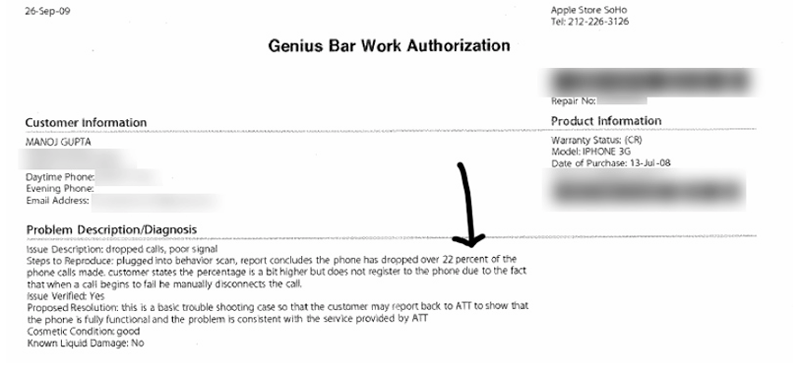
A man who took his iPhone 3G in to a New York City Apple Store because of a large number of dropped calls was allegedly told that a 30 percent failure rate is average for a local AT&T customer.
In a diagnosis issued by the Genius Bar, the proposed resolution for the issue was for the customer to contact AT&T, because “the problem is consistent with the service provided” by the wireless carrier. Not included in the report, however, is what a Gizmodo reader claimed he was told by the Apple Store Genius: That a 30 percent dropped call rate is average for the New York area.
The man took his iPhone 3G to the Apple Store in SoHo, located at 103 Prince Street in New York City, to see if his dropped calls were as a result of the hardware. The man said that roughly a third of his calls disconnected. Read more…